ANTI-TILT FOR FUTURES TRADERS
Tilt blows the account.
Meridian catches it before the order.
Revenge trading, oversizing, moving stops, overtrading — the loss that ends a funded account is usually behavioral, not strategic. A daily loss limit only sees the number, after the damage. Meridian reads the behavior across seven signals in real time and steps in while you can still walk away.
Free forever, no card · Guard $29.99/mo, cancel anytime · NinjaTrader 8 today · Tradovate & Ironbeam early access
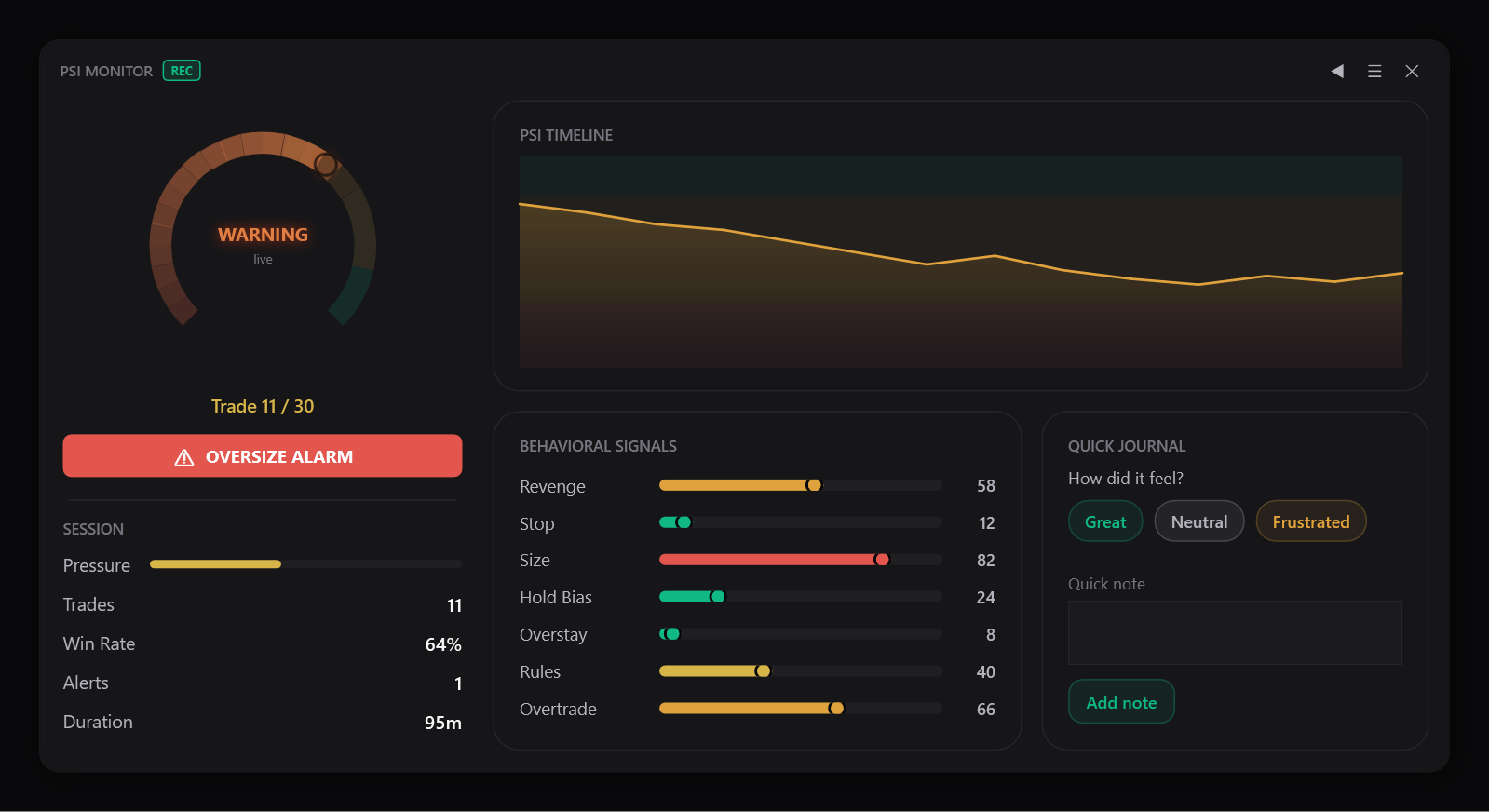
WHAT TILT ACTUALLY IS
Tilt is a sequence, not a mood.
Tilt is the predictable shift in how you execute after something goes wrong — a stop-out, a missed setup, a string of losses. The decision system that worked an hour ago quietly tips toward getting even and away from the plan. You already know the shape of it: re-enter fast, size up, give the stop more room, trade more often, ignore the rules you set when you were calm.
Because it is a sequence, it is detectable — each step leaves a fingerprint in your order flow before it shows up in your P&L. Anti-tilt is the discipline of catching that sequence one layer earlier than any financial threshold can. Limit-based tools watch the number; Meridian watches the behavior that produces the number.
THE TILT, MAPPED TO THE SIGNAL
Every way tilt shows up,
and the signal that catches it.
Each behavior is scored in real time, against your own history.
You take the loss back. Re-enter fast, same direction, bigger.
Rapid re-entry after a loss with elevated size in the same direction.
“This one makes it back.” Size creeps past the rule you set when calm.
Position size exceeding your own declared rule — heavier during losing streaks.
The trade goes against you, so you give it room. Then more room.
Stop distance widening in the adverse direction after price moves against the position.
Entries speed up. You are trading the screen, not the plan.
Entry frequency accelerating past your historical session rhythm.
You cut winners fast and nurse losers, hoping for the round-trip.
Holding losing trades far longer than winning ones — the loss-aversion pattern.
Past the cutoff time, past the loss-streak line — and trading anyway.
Declared session rules — time windows, stop range, loss-streak — being crossed.
A seventh signal — Position Overstay — flags a single losing trade held past your historical patience window into deep adverse excursion, even if it later recovers. All seven combine into one live PSI score.
WHEN EACH ONE FIRES
A limit fires at trade four.
Anti-tilt flags at trade two.
Same tilt sequence, one session. Watch where each layer reacts.
| What you do | A daily loss limit | Meridian (anti-tilt) |
|---|---|---|
| Trade 1 — stop-out | Silent. P&L is fine. | Logs the loss. Baseline still calm. |
| Trade 2 — fast re-entry, +1 contract | Silent. Still under the cap. | PSI dips. Revenge Entry + Size Spike flag. |
| Trade 3 — stop widened, size up again | Silent. Still under the cap. | PSI hits Warning. Guard can require an Acknowledge — type your phrase, wait out the countdown. |
| Trade 4 — the one that breaks the day | Fires — at −$500, after the damage. | Already blocked the add, or paused the session. |
The loss limit catches you at −$500 — after four revenge trades.
Meridian starts flagging at trade two.
INTERVENTION, NOT A POST-MORTEM
It steps in before the order — not after the loss.
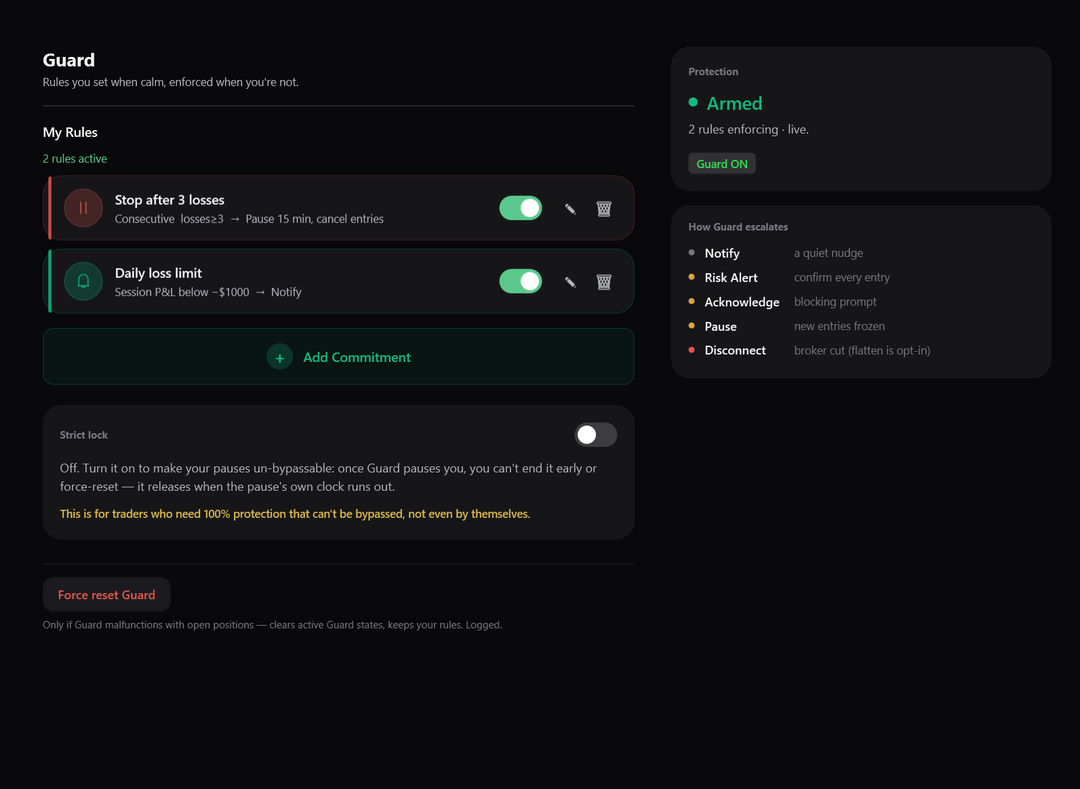
Detection is only half of anti-tilt. When PSI crosses a line you set while calm, Meridian Guard escalates exactly as far as you decided in advance:
- 1 Notify — a quiet alert; you see your PSI dropping
- 2 Risk Alert — a persistent banner; it doesn't block entries, it keeps the risk in front of you
- 3 Acknowledge — type your own pre-written phrase and wait out a countdown
- 4 Trading Pause — blocks new entries by cancelling orders
- 5 Disconnect — severs the broker connection; the session is over
Strict Lock holds every pause it fires for its full window — no in-app early exit or force-reset — for exactly when the tilted version of you wants to switch it off.
By default Guard stops you adding risk rather than closing what you hold — you can always exit any position, any time. Tick auto-flatten on a Trading Pause or Disconnect rule and Guard will close your open positions the moment it fires.
NOT A DIFFERENT TOOL. A STRONGER ONE.
Keep every limit you trust.
Add the layer that stops tilt.
Anti-tilt is not a replacement for your loss limit — it is the upgrade that wraps around it. Tricycle vs. car: if you already run a risk tool, Meridian does everything it does, plus the behavioral layer it is blind to.
- ✓Daily loss limit
- ✓Single-trade loss cap
- ✓P&L / drawdown caps
- ✓Loss-streak cutoff
Meridian does all of this too — these are Guard's trigger types.
- ✓Real-time behavior detection — revenge, oversizing, tilt
- ✓A baseline that learns how you trade
- ✓Intervention before the order, not after the loss
- ✓Order-layer Hard limits — a max-contracts cap and blocked entry order types, rejected at submission
- ✓The whole loop: monitor · guard · journal · Intel analytics · 5-year history
No limit-based tool can do this.
WHY THIS LAYER MATTERS
The losses that end accounts are behavioral.
The strategy you spent months building is rarely the failure point. The failure point is one session where tilt produced a loss sequence the strategy itself never permitted — entries you would have rejected the day before, sizing you had explicitly ruled out, a stop you moved twice.
Every earlier generation of risk tooling fires after that sequence has already played out. Anti-tilt fires inside it — while you still have the option to step away. Often that is the difference between losing a funded account and keeping it.
QUESTIONS
Anti-tilt, answered.
- What is tilt in trading?
- Tilt is the predictable shift in execution behavior that follows an unfavorable event — a stop-out, a missed setup, a string of losses. The decision system that worked an hour ago becomes biased toward getting even, away from your plan. It shows up as revenge entries, widening stops, oversizing, accelerating entry pace, and ignoring rules you set when you were calm.
- How does Meridian detect tilt in real time?
- Meridian watches your order flow against your own session history and scores seven behavioral signals after every fill — Revenge Entry, Size Spike, Stop Manipulation, Overtrading Pace, Hold Bias, Position Overstay, and Rule Violations. They combine into one live Psychological Stability Index (PSI) score that moves through Stable, Caution, Warning, and Critical as tilt builds — before your P&L reflects it.
- How is anti-tilt different from a daily loss limit?
- A daily loss limit reacts to a number — it fires after the loss has already happened. Anti-tilt reacts to the behavior that produces the number, one layer earlier. Meridian does everything a limit-based tool does (daily loss limit, P&L and drawdown caps, single-trade loss cap, loss-streak cutoff), then adds the behavioral layer none of them have: it catches the revenge trade at trade two, not the breach at trade four.
- Can Meridian stop a revenge trade before I place it?
- Yes — that is the point. When a behavioral threshold is crossed, Meridian Guard can escalate exactly as far as you decide in advance: Notify, Risk Alert, Acknowledge (a typed phrase with an optional countdown), Trading Pause, or a broker Disconnect. By default Guard blocks you from adding risk rather than closing what you hold — you can always exit any position, any time — and if you tick auto-flatten on a Trading Pause or Disconnect rule, Guard will close your open positions for you the moment it fires.
- Does anti-tilt only matter after a losing trade?
- No. Tilt can start from a missed setup, an unexpected gap, an early winner you are now scared to give back, or plain session fatigue. The seven signals cover the full spectrum, and PSI reflects cumulative behavioral pressure regardless of whether your last trade was a win or a loss.
Catch the behavior.
Skip the breach.
Everything your risk tool does — plus the anti-tilt layer that actually saves the account.
Free forever, no card · Guard $29.99/mo, cancel anytime · NinjaTrader 8 today · Tradovate & Ironbeam early access