THE LIVE MONITOR
One number tells you
when you're about to break your plan.
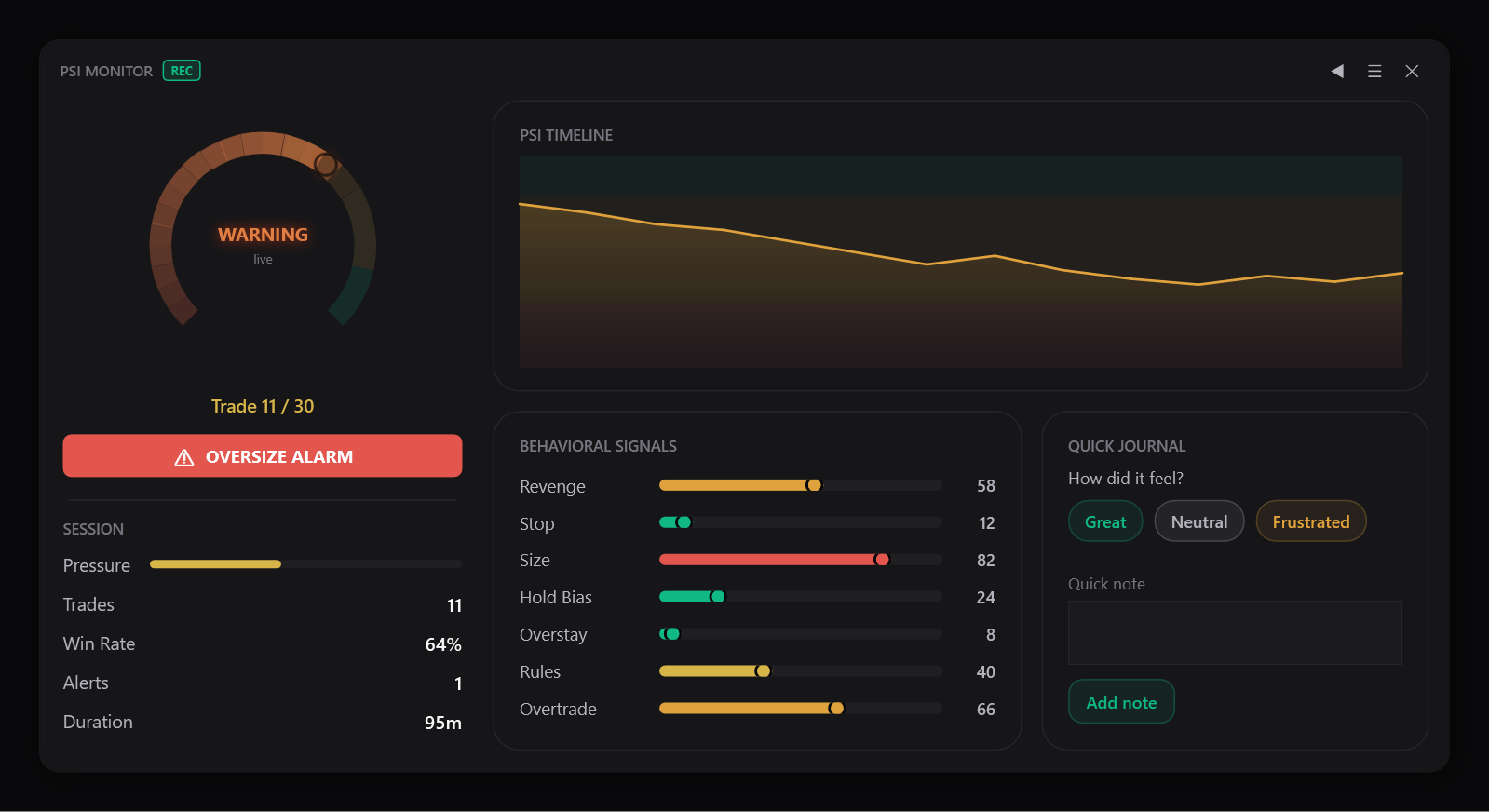
Meridian reads your order flow as you trade and turns it into a single live score from 0–100 — refreshed in under 100ms after every fill, measured against your baseline. When discipline starts slipping, you see the number move before your P&L does.
Free forever, no card · Guard $29.99/mo when you want enforcement · Cancel anytime
WHAT THE MONITOR DOES
It watches how you trade — not just how much you've lost.
A daily loss limit only knows one fact: your P&L. The Monitor reads the behavior underneath it. Every fill, every stop edit, every re-entry is scored against the way you normally trade, then composited into a single live figure — the Psychological Stability Index, or PSI.
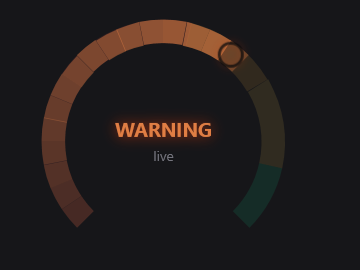
You don't have to read seven dials. You read one. A high score means you're trading like your composed self. A falling score is the early warning — it moves while you still have a choice, not after the account is already down.
- ✓Seven behavioral signals rolled into one number you can watch drop in real time
- ✓Measured against your baseline — not a generic average
- ✓An always-on HUD that sits over your NinjaTrader 8 chart
HOW THE NUMBER MOVES
From a fill to a score, in three steps.
The PSI isn't a guess about your mood — it's a precise read of your order flow against your own history.
A fill, a stop move, an exit, a re-entry. Meridian reads it natively the instant it happens — inside NinjaTrader 8 or straight from your Tradovate / Ironbeam account — nothing to log by hand.
Each behavioral signal compares the event to your calibrated baseline — your normal size, pace, hold time, stop discipline — and updates its own contribution.
The seven signals roll into one figure on the gauge and the timeline — the whole loop finishing in under 100ms, so the number is live, not a replay.
A loss limit fires once, at −$500.
The Monitor re-scores after every single fill — so you see the drift, not just the damage.
THE SEVEN SIGNALS
Seven reads. One score.
Each signal tracks one distinct way discipline breaks down. They run independently, then composite into the single PSI on the gauge.
Re-entering too quickly after a loss.
Widening or moving your stop when the trade moves against you.
Position size exceeding your declared rule — heavier weight during losing streaks.
Cutting winners quickly but letting losers run — your losing trades sit far longer than your winning ones.
Sitting in a single position well past your own typical hold time — long after your plan said to be out.
Trading outside the rules you set in your own profile.
Entry frequency accelerating past your normal session rhythm.
The signals only fire on the behaviors that quietly blow accounts — not on good discipline. Exit early, size down, walk away, and the score reflects it.
SCORED AGAINST YOU
A generic average doesn't know your edge.
A scalper firing 40 entries an hour and a swing trader holding for a session are not the same trader — and one fixed rulebook can't grade both. So the Monitor doesn't use one. It learns your normal: your usual size, your typical pace, how long you hold winners versus losers, how you handle stops.
That baseline is what makes the score honest. A size that's routine for you doesn't ding you — the same size does the day it's three times your norm and you're chasing a loss back.
The baseline adapts as your trading evolves, so the score keeps measuring you against you.
Native add-on inside NinjaTrader 8 — no bridge, no manual logging. On Tradovate or Ironbeam accounts, a standalone app reads your order flow directly (early access).
Never your name, broker credentials, account numbers, or funds. Local-first — your fills, baseline, and session history stay on your machine.
The Monitor reads and warns. When you want it to step in, Guard enforces the limits you set — before the order, not after the loss.
WHERE THE MONITOR FITS
The read is step one of the loop.
The Monitor is how Meridian sees. See the full picture — every layer, and what enforces it.
See the number move
before the loss does.
Put the live Monitor on your chart and read your discipline in real time — scored against you.
Free forever, no card · Guard $29.99/mo, cancel anytime · NinjaTrader 8 today · Tradovate & Ironbeam early access