How Meridian works
See behavioral pressure live. Review it after the session.
Meridian is built for active traders who want more than P&L. It shows PSI in real time, reveals what is driving the score, and gives you review tools built around discipline and stability.
Live PSI
See your trading stability while the session is still unfolding.
PSI updates during the session as fills, holding behavior, and rule pressure change. The goal is not just to show that something changed, but to show when behavioral pressure is building before the next decision.
Live PSI updates in under 100ms
Meridian refreshes PSI immediately after fills and continues tracking conditions such as holds and rule compliance during the session. You get feedback in the decision window, not just after the trade closes.
Three zones with clear meaning
Stable (PSI ≥ 88) means your behavior is consistent with your history. Caution (55–87) signals emerging pressure — one or more patterns are active. Critical (below 55) is a clear signal to pause and reassess before compounding mistakes.
Every score has visible drivers
Each drop in PSI maps to one or more behavioral dimensions. Instead of a single opaque number, you can see which pattern is creating pressure and why the score moved.
Behavioral signals
Seven signals tied to recognizable trading failure modes
Meridian turns familiar lapses in discipline into visible signals, so you can see which pattern is creating pressure instead of guessing from P&L alone.
Revenge Entry (D1) — re-entering after a loss
Flags rapid re-entry after a loss with elevated size in the same direction. Direction reversals are weighted less heavily to distinguish technical flips from emotional retaliation.
Stop Manipulation (D2) — moving risk wider
Tracks stop distance over time and detects widening in the adverse direction after price moves against you. This captures the classic impulse to give a losing trade more room than planned.
Size Spike (D3) — sizing above your rule
Penalizes size that exceeds your declared rule, with heavier weight during losing streaks when the impulse to make it back is strongest. Personal history is used to avoid generic thresholds.
Hold Bias (D4) — abnormal hold duration
Compares your current hold times against your personal baseline to detect both cutting winners too early and holding losers too long. Both are behavioral signatures of pressure — and both are detected against your own history, not a generic benchmark.
Position Overstay (D5) — holding losers too long
Monitors open positions every 30 seconds and activates when a losing trade exceeds your historical tolerance window. Deep adverse excursion is recorded even if the trade later recovers.
Rule Violations (D6) — breaking declared session rules
Checks your declared session rules, including time windows, stop-loss range, and loss-streak behavior. Violations apply scored penalties with cooldowns to prevent noisy double-counting.
Overtrading Pace (D7) — accelerating entry frequency
Measures both intra-session acceleration and deviation from your historical entry rhythm. A cold-start ramp helps avoid false positives on the first trade of the session.
Session review
Review behavior after the session, not just the outcome.
Meridian keeps a usable history of PSI, alerts, and behavioral pressure so you can study how a session unfolded, not just whether it finished green or red.
Session-level PSI and discipline review
Review each session with more context than P&L alone. Meridian helps you inspect stability, behavioral pressure, and rule alignment so you can see whether a good result was actually disciplined.
Behavioral timeline and alert history
PSI snapshots and alert history make it easier to see when pressure built, when it eased, and which signals were active along the way. That gives you a usable review path instead of a vague memory of the session.
Rolling history built for repeated patterns
Session history stores up to 5 years of daily summaries, up to 200 executions per session, and up to 600 PSI timeline snapshots. Older entries are pruned automatically, so history stays usable without manual cleanup.
Personalization
Built around your history, your rules, and your trading style.
Meridian does not compare you to a generic industry average. It learns from your own sessions and can be configured to fit different workflows, rules, and execution styles.
Your baseline updates automatically
Running statistics are updated after every session, so Meridian keeps learning what normal looks like for you. The baseline stays current without treating every trader as if they should behave the same way.
Early history is gentler. Mature profiles are sharper.
Signal weighting becomes more confident as your sample size grows. Early sessions stay less aggressive; more mature profiles become more precise because the plugin has better evidence for what is normal for you.
Profile settings fit different styles and rule sets
Detailed profile settings let you tune time windows, stop conventions, size rules, and workflow assumptions so Meridian can fit different trading styles instead of forcing a one-size-fits-all setup.
Test Mode and Market Replay stay out of live history
Test Mode can run PSI in real time without writing to your baseline, and Market Replay sessions are excluded automatically. You can practice, explore settings, or replay markets without polluting your live profile.
Scoring model
Pressure builds quickly. Recovery takes time.
Meridian treats behavioral pressure as something that accumulates under stress and fades only through time and consistent discipline.
Fast rise, slower recovery
Each dimension uses separate attack and recovery behavior. Pressure from a violation builds quickly, while recovery requires sustained discipline, so one mistake can fade but repeated behavior stays visible.
Overnight carry keeps unresolved pressure visible
Behavioral pressure does not automatically reset at midnight. Meridian carries unresolved pressure forward with time decay, so a rough Tuesday can still matter on Wednesday while longer breaks allow more recovery.
Persistent size violations stop recovery
When position size remains above your declared limit, recovery is held in place until size comes back into line. The system reflects the reality that ongoing violations should not look resolved just because time passed.
Privacy and deployment
Runs locally. Works with real-world account setups.
Meridian is a native NinjaTrader 8 add-on. Your fills, baseline, and session history stay on your machine while the plugin monitors connected accounts in real time.
No accounts, no cloud, no telemetry
There are zero HTTP calls in the codebase. No analytics, no crash reporting, and no license-check pings. Computation happens on your PC, and data stays under your control.
Multi-account and Replikanto support
Meridian monitors all connected NinjaTrader accounts simultaneously. Replikanto copy-fills are deduplicated within a 250ms window to prevent double-counting, and prop firm disconnects are handled gracefully.
Local storage you control
Configuration, baseline data, and session history are stored locally in XML files on your machine. You keep the practical benefits of review history without depending on a web service.
PSI is a behavioral proxy index derived from your trading activity inside NinjaTrader. It does not measure physiology (for example heart rate or stress hormones), and it is not validated as a predictor of trading profits or losses. Meridian is designed to improve self-awareness and discipline during a session; outcomes still depend on many factors beyond psychology.
Two distinct metrics
PSI and Composure are not the same thing
Meridian tracks two separate measures of your behavioral state. Understanding the difference helps you use both correctly.
PSI — Real-time score
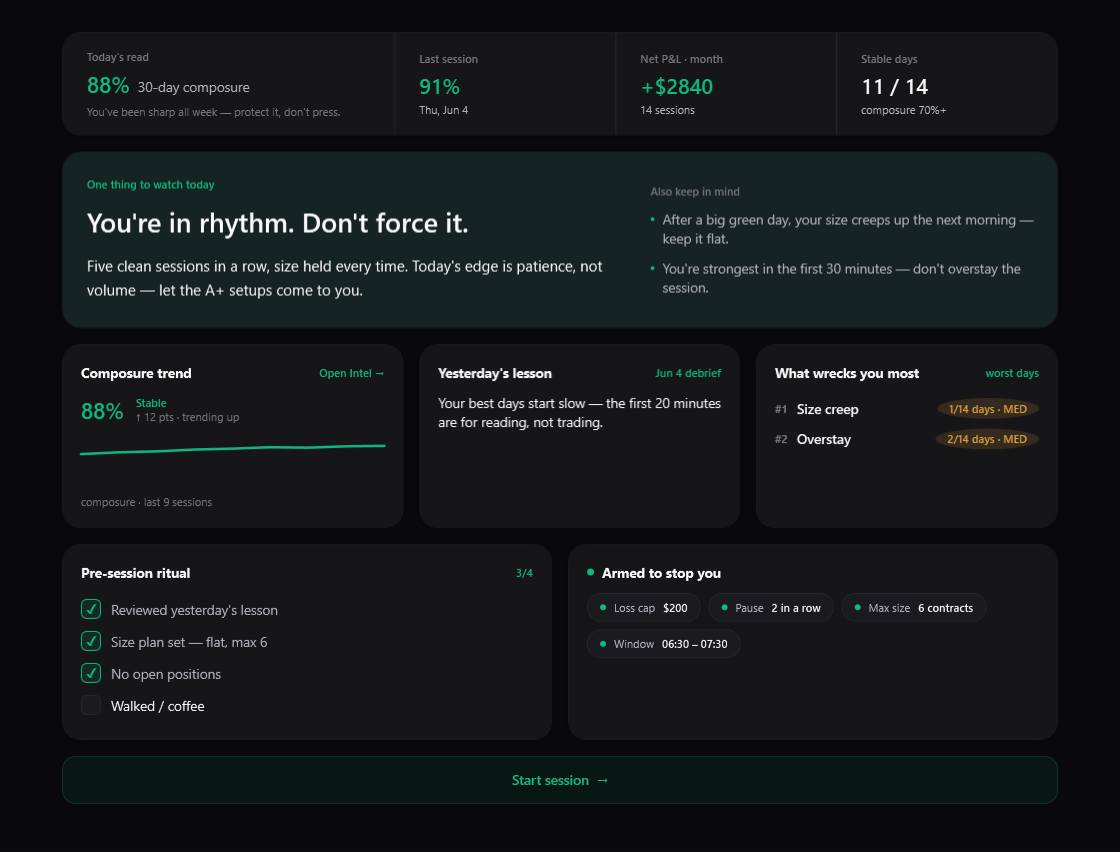
0–100. Updates live after every fill and continuously during the session as holds, time, and rule compliance change. Three zones: Stable (≥88), Caution (55–87), Critical (<55).
Used for in-session decisions. Visible in the HUD and as a Guard trigger condition.
Composure — Session quality score
0–100%. Calculated at session end. It reflects how much time you spent in each PSI zone: time in Stable is weighted 1.0×, Caution 0.3×, Critical 0.05×. A long session in Caution will have low Composure even if your PSI looked acceptable.
Used in Intel Tab, session history, and monthly digest. Not displayed live during the session.
Example: a trader whose PSI stayed around 75 (Caution) for a 4-hour session would show a Composure of approximately 30% — despite the PSI number looking moderate. The two metrics measure different things.
Meridian Guard
Rules that enforce themselves.
Guard adds a commitment-device engine and an Intel Layer to Meridian. Six trigger conditions, five action levels, five years of session history, and a monthly digest — all built around the rules you write yourself, when you are calm.
PSI is a behavioral proxy index derived from your trading activity inside NinjaTrader. It does not measure physiology (for example heart rate or stress hormones), and it is not validated as a predictor of trading profits or losses. Meridian is designed to improve self-awareness and discipline during a session; outcomes still depend on many factors beyond psychology.
See it in your own sessions.
7-day free trial · $24.99/month after · cancel any time · NinjaTrader 8 required. Trading involves substantial risk of loss. Meridian does not guarantee trading results.